
Sitemap index files for large websites
A single sitemap can hold 50,000 URLs. Large websites, online shops and sites that publish every day often need more than that, or simply want to organize their URLs better. The answer is a sitemap index: one file that lists your other sitemaps.
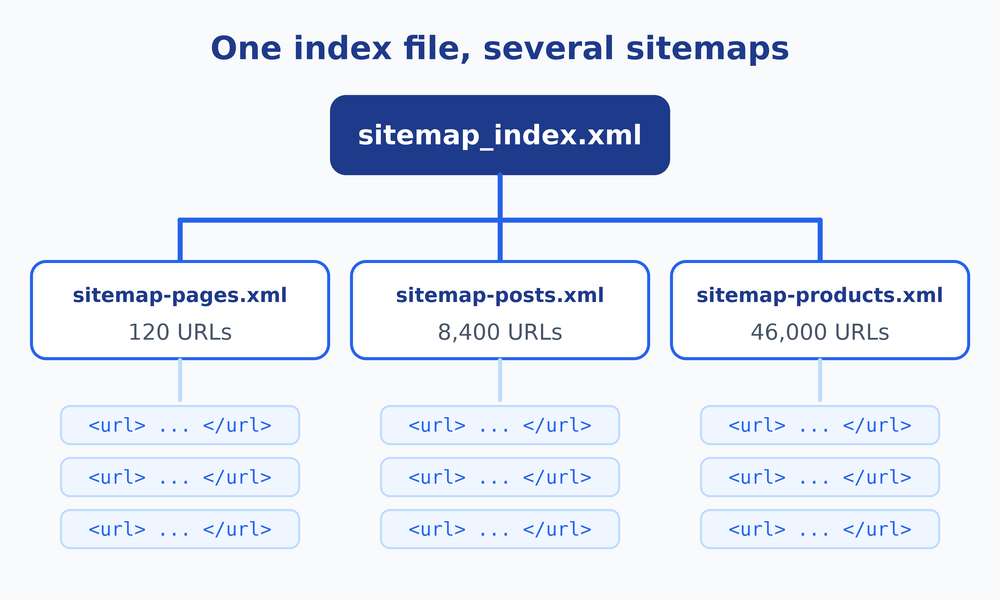
When do you need a sitemap index?
The protocol sets two limits for each sitemap file: 50,000 URLs and 50 MB uncompressed. As soon as your site goes over either one, you must split the list into several files. An index is then the cleanest way to tell search engines about all of them at once.
Many sites use an index well before reaching the limits, because separate sitemaps make reports easier to read. If your products, your blog posts and your category pages each have their own file, Search Console shows indexing figures for each group. A problem with one type of page stands out immediately.
The format of an index file
An index file looks like a sitemap, with different tag names:
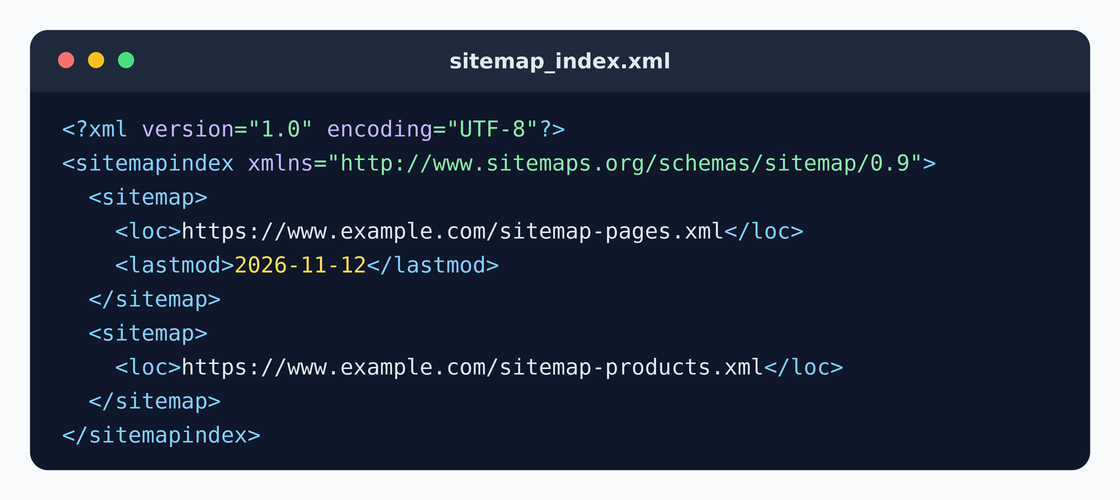
<?xml version="1.0" encoding="UTF-8"?>
<sitemapindex xmlns="http://www.sitemaps.org/schemas/sitemap/0.9">
  <sitemap>
    <loc>https://www.example.com/sitemap-pages.xml</loc>
    <lastmod>2026-11-12</lastmod>
  </sitemap>
  <sitemap>
    <loc>https://www.example.com/sitemap-products.xml</loc>
  </sitemap>
</sitemapindex>- <sitemapindex> replaces
<urlset>as the root element. - <sitemap> replaces
<url>, with one block per child sitemap. - <loc> gives the absolute address of each child sitemap.
- <lastmod> is optional and gives the date the child file was last changed. It helps search engines decide which file to read again first.
The rules to respect
- One index file can list up to 50,000 sitemaps, and it is also limited to 50 MB.
- No nesting: an index can only point to sitemaps, never to another index.
- The child sitemaps should be on the same host as the index, and ideally in the same folder or below it.
- Child sitemaps can be compressed with gzip (
sitemap-products.xml.gz). The 50 MB limit applies to the uncompressed size.
Good ways to split your URLs
| Split by | Example files | Best for |
|---|---|---|
| Content type | sitemap-pages.xml, sitemap-posts.xml, sitemap-products.xml | Most sites: clear reports per type |
| Date | sitemap-2025.xml, sitemap-2026.xml | News sites and blogs with a long archive |
| Language or section | sitemap-en.xml, sitemap-es.xml | Multilingual sites in subfolders |
| Fixed blocks | sitemap-1.xml, sitemap-2.xml | Very large catalogs generated automatically |
Splitting by date has a hidden advantage: the files for past years almost never change, so search engines can skip them and focus on the file that holds your recent content.
Submitting an index
Submit the index the same way you would submit a sitemap: one Sitemap: line in robots.txt and one entry in Google Search Console. Search Console then lists every child sitemap under the index, with its own status and URL count. There is no need to submit each child file separately.
And for smaller sites?
If your site has a few hundred or a few thousand pages, a single sitemap is perfectly fine and simpler to maintain. sitemapauto.com crawls up to 5,000 pages and delivers them in one valid sitemap.xml file, which covers the vast majority of small and medium websites.
Frequently asked questions
How many URLs can a sitemap contain?
Up to 50,000 URLs, and the file must not exceed 50 MB uncompressed.
Can a sitemap index contain another sitemap index?
No. An index can only point to regular sitemap files.
Do I need to submit each child sitemap separately?
No. Submit the index and search engines will read every sitemap listed in it.
Is it bad to have many small sitemaps?
No. Splitting by content type is common and makes indexing reports easier to read.
Sitemap guides
Another free tool we built
Validate your whole site, not one page at a time
W3cvalidator.com crawls your website and checks your pages against W3C standards automatically, up to 1,500 pages in a single run. Far faster than validating each page by hand, and a good way to catch the markup errors that hurt accessibility.