
XML sitemap best practices
A sitemap is only useful if search engines can trust it. A clean file lists the right pages, in the right form, with honest dates. Here is what to include, what to leave out, and the mistakes that show up most often in Search Console.
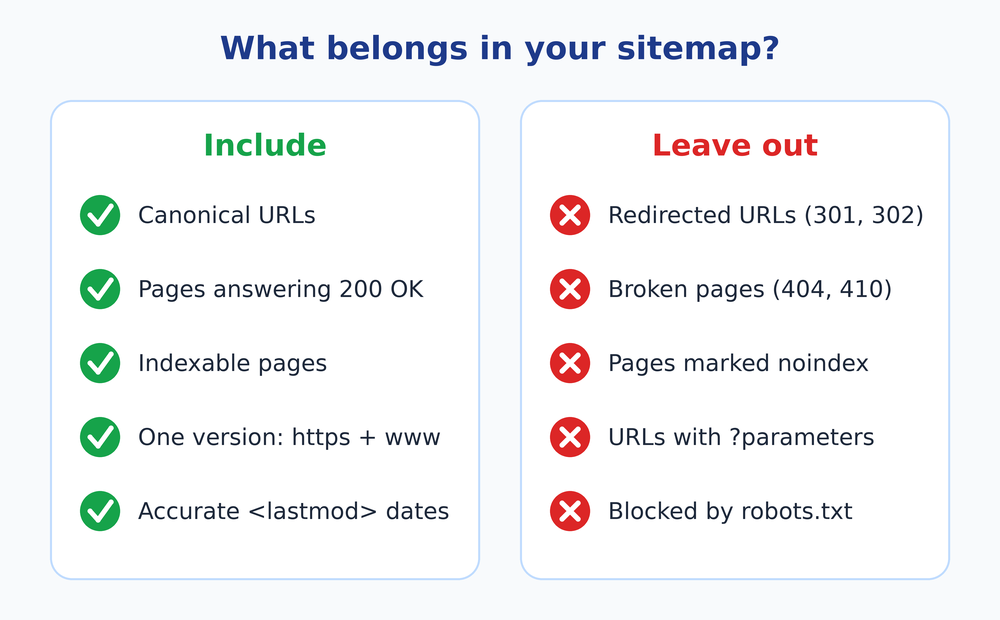
List only the pages you want in search results
Think of your sitemap as a list of recommendations. Every URL in it says "this page is worth indexing". If a third of the list turns out to be redirects, errors or duplicates, search engines learn that your recommendations are unreliable. A clean sitemap contains:
- Canonical URLs only. If a page declares another address in its
rel="canonical"tag, list that other address, not this one. - Pages that answer with a 200 code. No 301 or 302 redirects, no 404 or 410 errors, no server errors.
- Indexable pages. A page with a
noindextag has no place in the sitemap. - A single form of each address. Choose between http and https, with or without www, with or without a trailing slash, and stick to it everywhere.
What to leave out
- Parameter URLs such as
?sort=priceor?sessionid=, which show the same content as the main page. - Pages blocked in robots.txt. Listing them sends two opposite signals.
- Internal search results, carts, account pages and thank-you pages. They have no value in search results.
- Thin or duplicate pages such as empty tag pages or print versions.
Keep the lastmod dates honest
Google has said that it uses lastmod when the dates are consistently accurate, and ignores changefreq and priority. Change the date only when the main content changes: a new paragraph, an updated price, a corrected fact. A new copyright year in the footer or a changed sidebar does not count. If you cannot produce reliable dates, leave the tag out rather than filling it with today's date.
Keep the file up to date
An old sitemap slowly fills up with deleted pages and misses the new ones. Generate it again whenever you publish a batch of pages, delete a section, or change your URL structure. On a site that changes every day, the sitemap should be produced automatically by the publishing system. On a site that changes a few times a month, regenerating it with a crawler and uploading it again is enough.
Technical checklist
| Point to check | Expected value |
|---|---|
| Encoding | UTF-8, with special characters escaped (&) |
| URLs | Absolute, same protocol and same host as the site |
| Size | 50,000 URLs and 50 MB maximum per file |
| HTTP response of the file | 200, readable without a login, not blocked by robots.txt |
| Location | At the root, declared in robots.txt |
| Compression | Optional, gzip accepted (.xml.gz) |
The most common errors in Search Console
- "Submitted URL not found (404)". The page was deleted or renamed but is still listed. Generate the sitemap again.
- "Page with redirect". The sitemap lists an old address. Replace it with the final one.
- "Excluded by noindex tag". Either remove the tag, or remove the URL from the sitemap.
- "Duplicate, Google chose different canonical than user". Two addresses show the same content. Keep only the one you consider canonical and make sure your internal links use it.
- "Blocked by robots.txt". A Disallow rule covers a URL you listed. Change the rule or the list.
- "Sitemap could not be read". The XML is malformed, often because of an unescaped ampersand or a file saved in the wrong encoding.
Do not forget internal links
A sitemap helps search engines find pages, but it does not tell them a page is important. Internal links do that. A page that appears in the sitemap but receives no link from the rest of the site will often be crawled rarely and ranked poorly. Use the sitemap as a safety net, and make sure your menus and your content link to the pages that matter.
sitemapauto.com applies most of these rules for you: it follows your internal links, stays on your own domain, and keeps out every URL that answers with an error. You also get a report of the broken links it found along the way.
Frequently asked questions
Should every page of my site be in the sitemap?
No. Only the pages you want to see in search results: canonical, indexable and working pages.
Does the order of URLs in the sitemap matter?
No. Search engines do not give more weight to the first URLs of the file.
Should I include my images in the sitemap?
Not as separate URLs. Images can be described with the image sitemap extension, inside the entry of the page that displays them.
Can a bad sitemap hurt my rankings?
It will not cause a penalty, but a sitemap full of errors wastes crawl time and makes search engines trust your file less.
Sitemap guides
Another free tool we built
Hunt down the broken links on your site
Bye404.org automatically scans a website and reports every dead link and 404 page it finds, broken images included. Broken links frustrate your visitors and waste crawl budget, so they are worth fixing before search engines run into them.